Pastor Chris Brademeyer’s Podcast
This podcast consists of the sermons and thoughts of Pastor Chris Brademeyer, a Lutheran Pastor (LCMS) from North Dakota.








Episodes

6 hours ago
6 hours ago
20 min
For those of you live in houses, you know that they need to be fixed from time to time. The roof won’t last forever; it needs to be replaced every so often. Lawnmowers need oil changes and new blades. Fences need to be mended. Even houses that have stood for generations will fall apart without maintenance. Simply put, there things in this life that need to be repaired from time to time.
The same is true of the Church. This is not because Christ is an unreliable foundation, or because His Word becomes irrelevant or outdated, but because sinners in the Church are continually tempted to depart from His Word. We are tempted to replace His truth with our own ideas. We are tempted to trust in ourselves rather than in Him. We are tempted to make the Church into something that pleases us and that matches the conventions of our time rather than remaining faithful to the One who purchased her with His blood.

5 days ago
5 days ago
15 min
There are few things more insulting to a host than receiving an invitation and refusing to attend. Imagine that a king invites you to the wedding feast of his son. Everything is prepared. The food is ready. The celebration is about to begin. And you simply refuse to come. Some of you might even be offended that the king expects you to attend. You have more important things to do. You have a business to run, a field to work, a family to care for, and a life to live. The king’s invitation can wait.
This is precisely the picture Jesus gives us in today’s Gospel. A king prepares a wedding feast for his son. He sends his servants to summon the invited guests, but they refuse to come. He sends other servants, explaining that everything is ready. The feast is prepared. The oxen and fat calves have been slaughtered. The table is set, everything is ready. Come to the wedding feast!

Oct 13, 2026
Oct 13, 2026
19 min
There is a difference between changing your behavior and becoming a new person. A person can change his habits without changing his heart. A man can quit one bad habit and take up another. He can learn to control his temper because it is socially advantageous. He can become more honest because dishonesty has consequences. He can work harder because he wants more money. Outwardly, he may look like a changed man, but outward improvement is not the same thing as Christian sanctification.
St. Paul speaks about something much more significant in our Epistle lesson. He says that Christians are to live differently than the pagans, even differently from what they were before they were brought to faith. He says, “Put off your old self, which belongs to your former manner of life and is corrupt through deceitful desires, and…be renewed in the spirit of your minds, and…put on the new self, created after the likeness of God in true righteousness and holiness.” Notice where this begins. It does not begin with, “Try harder.” It begins with Christ. The Christian has learned Christ. He has heard the truth that is in Jesus. He has been baptized into Christ. He has received forgiveness. He has been given a new identity and a new life.

Oct 13, 2026
Oct 13, 2026
11 min
There are some questions that are asked because a person genuinely wants to know the answer. And then there are questions that are asked because the person asking already thinks he knows the answer. The Pharisees' question in our Gospel is of the second kind. One of them, a lawyer, asks Jesus, "Teacher, which is the great commandment in the Law?" It sounds like a reasonable theological question. Indeed, it is an important question. What does God require of us? What is the most important thing that God commands His people to do?

Oct 13, 2026
Oct 13, 2026
12 min
Today’s topic is angels, given that this day is the feast of St. Michael and All Angels. On this day each year, the Christian church reflects on these servants of God. That is to say, we think about who the angels are, what their duties are, whether there are differences amongst them, and about how God created them. There is no shortage of ideas about these beings in contemporary society, some of which are confirmed in the Scriptures, others are the fabrications of legend and superstition that has arisen over the years.
Who are the angels? In brief, they are servants of God created by Him to serve Him.

Sep 29, 2026
Sep 29, 2026
23 min
The Christian is one. He is one with His Lord. He is one with the Lord’s Church. That is to say, our faith is one of unity. We are not fundamentally divided, we are fundamentally united. And our unity is not something that comes by force of human will or from our efforts, rather, it comes from God Himself. That unity expresses itself in a common confession, common doctrine, and a common life together. It is shown when we kneel to receive the Lord’s Supper. In other words, God makes us one by faith and our great responsibility is to confess that unity. St. Paul in our lesson today gives us four dimensions to our Christian unity: one Lord, one faith, one baptism, and one God and Father.
Compare this to the world around us: there are constant divisions between political parties, businesses, towns, schools, sports fans, and, sadly, even between Christian churches. There are so many foolish reasons for this. Money, land, pride, selfishness, and arrogance serve only to divide and destroy. And worst of all, the world is so confused about unity that it accuses those who hold fast to the truth of Christ of being divisive while labeling those who come with half-truths and outright falsehoods as being unifying simply because they do not demand real, actual, substantial unity. Besides this, we often confuse unity with uniformity, seeing outward commonality as the sign of unity rather than deep and abiding common substance.

Sep 29, 2026
Sep 29, 2026
10 min
Jacob and Jacy, today you are doing something both very ordinary and very extraordinary. Ordinary, because for thousands of years men and women have stood before their families, their friends, and their God and promised themselves to one another in marriage. Extraordinary, because today God Himself joins the two of you together as husband and wife. This universal, God-given reality is where our Lord Jesus directs our attention with His words here. He did not begin with your feelings. He did not begin with your plans for the future. He did not begin with your inner selves. He began with God.

Sep 26, 2026
Sep 26, 2026
10 min
Gerry knew something about gathering. I mean, the man bled hunting and fishing. He loved the pursuit and he loved getting the good shot, the good game, landing the big fish. And if you gave him half of an opening, you got an earful of the things that he hunted and the walleyes he caught on Kraft. He gathered a crop each fall, doing that work that characterized farming. So, it stands that Gerry knew something about gathering. But it wasn’t just hunting and fishing, despite how much he talked about it. It was also all of you. Gerry is one of those guys that everyone knows. He gathered to himself a loving wife in Dee, two sons and their families, and numerous friends and family along the way. Gerry said more than once to me and to at least Matt that the only thing he regretted about having to die and leave us is leaving all of you behind.
Gerry was good at gathering. And this should not surprise us. Gerry didn’t just live a life characterized by it, but his life was formed by it from the beginning. Gerry was born on August 24, 1949 and only a few short weeks later, he was gathered. He was not gathered by family who came to see the new baby. No, he was gathered into the Kingdom of God by the Good Shepherd who called Gerry to Himself in holy Baptism.

Sep 26, 2026
Sep 26, 2026
13 min
Death is something often on my mind, particularly at this time of the year. I am not trying to sound morbid, but in my line of work, death is something that I encounter regularly. Indeed, we are going to bury a dear, sainted member of the church on Monday. I do not fixate on death because I like it, because I fear it, or because I have a morbid curiosity about it. Enough visits to the bedside of those who are in their last hours strips one of his curiosity about such things.
But death is not easily dismissed. It is relentless, hounding each and every one of us no matter what we might do to avoid it. It is greedy, it gobbles up men, women, and children; the young and old; the rich and poor. All will eventually be held by its cold embrace. Given enough experience with it and you too will find yourself thinking about it. And, I will admit, I do not like death. But even more, I do not want to meet it. It is not fear, not really, but that I know that death is often not pleasant and comes with great suffering. But the thing that most makes me pause, the one thing about death that grips me when it crosses my mind, is its inescapable nature.

Sep 26, 2026
Sep 26, 2026
14 min
Inflation. Depressed wages. High housing prices. Grocery bills through the roof. Gas pumps that require a mortgage to operate. It is easy to become anxious about such things. This isn’t unexpected either. After all, who doesn’t need food or shelter, clothes or transportation? But even more, seeing that a dollar does not stretch as far as it used to is very unsettling.
Such is the power that mammon, money and riches, exercises over us. Our possessions are a powerful thing in our lives in the sense that they control and relate to so much that we do. As the old saying goes, we put our money where we see value in putting it. So it comes to closely define our sense of security and safety. What can we do?
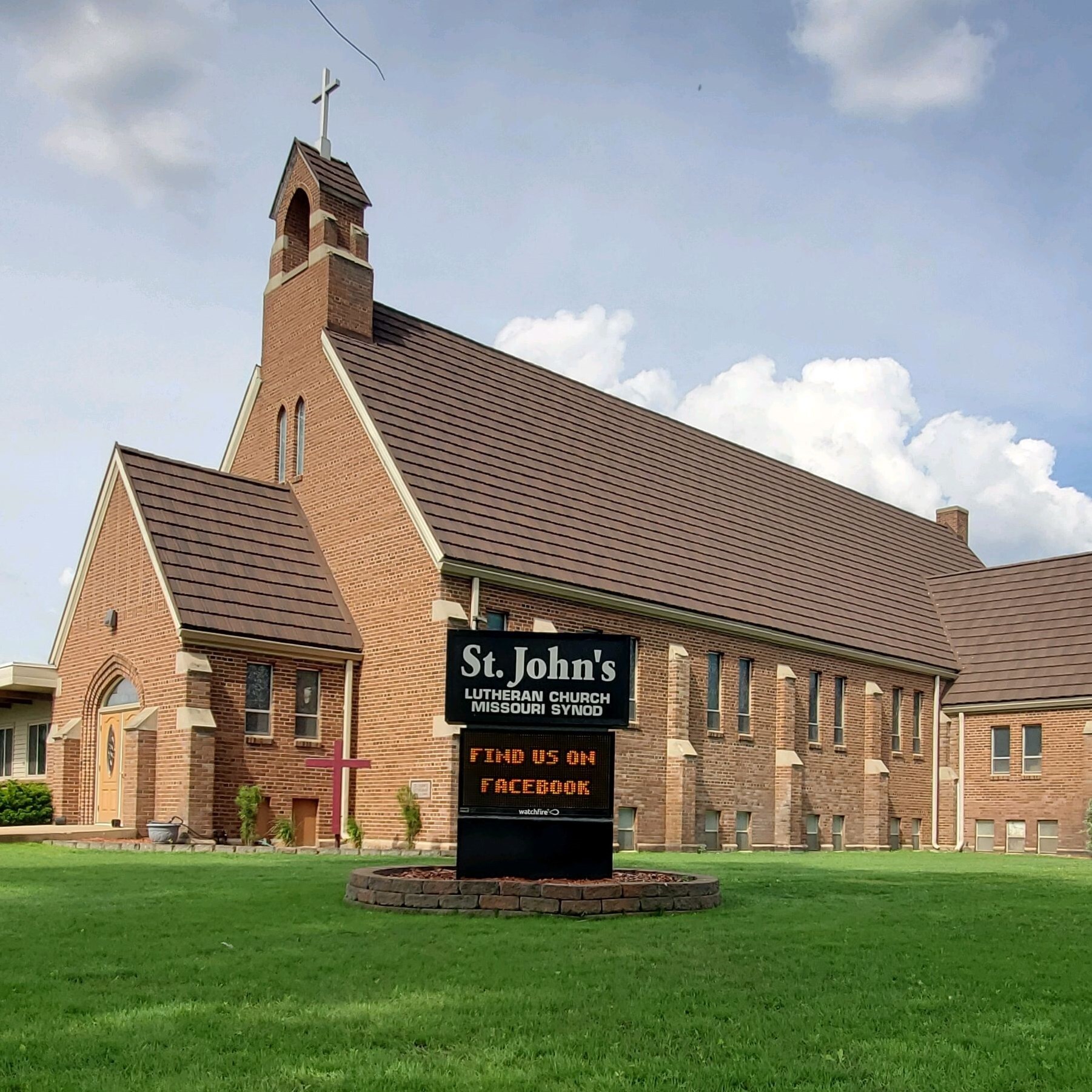
Find out in this sermon from St. John's Lutheran Church of Oakes, ND!